

For centuries, daughters were often ignored in matters of ancestral property, by a system that preferred male members. However, the times have changed. Today, a daughter’s right to her parents’ legacy is not just a moral claim; it is a legal reality.
To ensure that “rights on paper” become “assets in hand,” families need to move toward structured planning. This is where modern legacy tools become essential.
By organizing property deeds, bank details, and investment records in a transparent, secure environment like Mitt Arv, you remove the “grey areas” that families use to deny claims.
But if a family is denying a claim, they are often relying on outdated customs rather than current law when it comes to daughter’s property rights in India. Here is the legal reality to help you, as a daughter, to claim your ancestral property:
1. You Are a “Coparcener” by Birth
Before 2005, only sons were coparceners (legal heirs with a birthright). The Hindu Succession (Amendment) Act, 2005, changed Section 6 to ensure that a daughter becomes a coparcener in the same manner as a son. This means your right exists the moment you are born; it is not a “gift” from your father or brothers.
2. Marriage is Not a Disqualification
Your status as a coparcener in your father’s Hindu Undivided Family (HUF) is permanent. Whether you are married, divorced, or widowed, your claim to ancestral property remains unchanged.
3. The “Father’s Death” Myth
Some families claim that because the father passed away before the 2005 amendment, the daughter has no right. The Supreme Court in Vineeta Sharma v. Rakesh Sharma (2020) crushed this argument. The court ruled that as long as the daughter was alive in 2005, she could claim her share even if her father died decades earlier.
4. Right to Demand Partition
If you are being denied your share, you do not have to wait for your brothers to divide the property. As an equal coparcener, you have the legal right to file a Suit for Partition. This forces the legal division of the property so you can receive your specific portion.
The Great Shift: Daughters’ Rights Before and After 2005
The Hindu Succession (Amendment) Act of 2005 remains the most significant milestone for gender parity in Indian property law. By amending Section 6 of the original 1956 Act, the legislature removed the discriminatory barriers that prevented daughters from being coparceners (legal heirs by birth).
To understand the magnitude of this change, we must look at what came before and after:
Before the 2005 Amendments in Hindu Succession Act
- Excluded from Coparcenary: Daughters were not born with a right to ancestral property. Only male members such as sons and grandsons held this birthright.
- Dependency on Marital Status: Upon marriage, a daughter was often viewed as having “left” her natal family, further weakening her informal claim to the family estate.
- Limited to Self-Acquired Property: While daughters could inherit a portion of a father’s self-acquired property if he died without a will, they were legally barred from claiming a share in the joint family property.
- No Right to Partition: A daughter could not legally ask for the family property to be divided; she had to wait for a male member to initiate the process.
After 2005 Amendments: in Hindu Succession Act
- Coparcener by Birth: A daughter is now a coparcener by birth, exactly like a son. This right is independent of her marital status.
- Equal Shares and Liabilities: She is entitled to an equal share in the ancestral property and, by extension, is also liable for an equal share of the family’s debts.
- Right to Demand Partition: A daughter can now legally move the court to partition the ancestral property at any time.
- The Right to Manage: In many cases, daughters can now also become the Karta (manager) of the Hindu Undivided Family (HUF), a role previously reserved for the eldest male.
Landmark Case: The Vineeta Sharma Case (2020)
Even after 2005, a lingering question plagued the courts: Does the father have to be alive on the date of the amendment (September 9, 2005) for the daughter to claim her rights?
The Supreme Court provided a definitive answer in Vineeta Sharma v. Rakesh Sharma (2020). The court ruled that the right to ancestral property is a birthright. Therefore, it does not matter if the father passed away before 2005.
As long as the daughter was alive when the amendment came into force, her birthright to the ancestral property remains valid and enforceable. This ruling effectively cleared the retroactive hurdle, ensuring that no daughter is denied her share based on a technicality of dates.

Can a Father Exclude a Daughter from His Property Through a Will in India?
While the 2005 amendment grants equal rights in ancestral property, the rules for self-acquired property are different. Understanding this distinction is vital for every family.
- Self-Acquired Property: If a father built his wealth through his own earnings, he has the absolute right to give it to whoever he chooses via a will. He can technically exclude a daughter from this portion of his estate.
- Ancestral Property: A father cannot exclude a daughter from her share of ancestral property (property passed down through four generations of male lineage) through a will, as her right is established by birth.
- The Power of the Will: A will acts as the final word. If a father dies intestate (without a will), the self-acquired property is divided equally among all Class I heirs, including the daughter.
- Challenging a Will: A daughter can challenge a will in court if she suspects it was made under coercion or fraud, or if the property willed away was actually ancestral in nature.
Why a Will Is Non-Negotiable For Daughter’s Property Rights
While the law grants equal rights, passing away without a will is a recipe for chaos. When you die without a will, the law takes over with a rigid formula that may not reflect your family’s reality.
In 2026, with the rise of digital assets and complex investments, a will is no longer just a document for the wealthy. It is a survival kit for the middle class. It ensures that your daughter’s legal rights are complemented by your personal intent, preventing fragmented property and long legal battles.
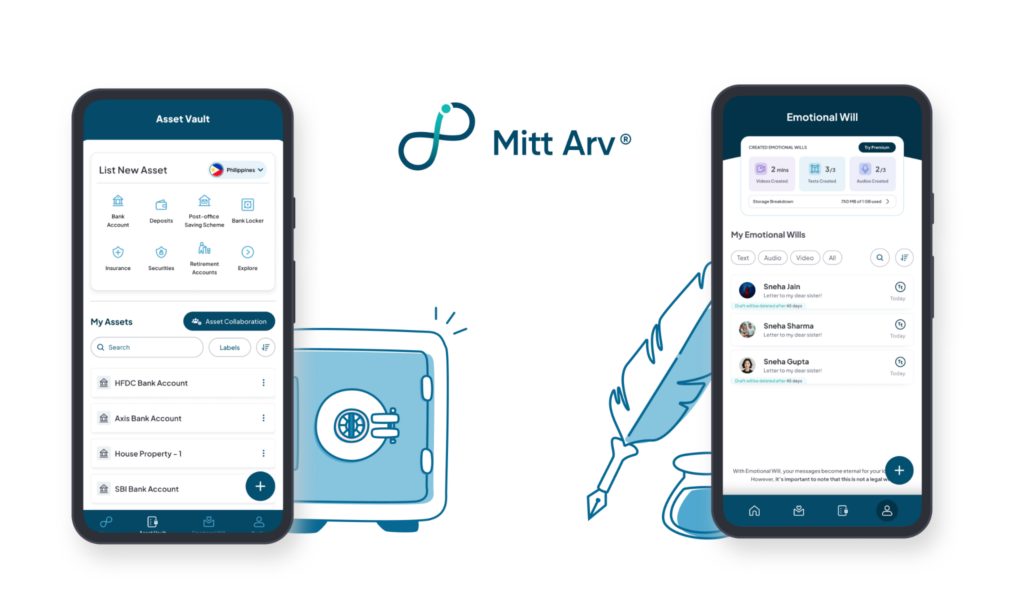
The Digital Solution: Legacy Planning with Mitt Arv
In an era where our lives are spread across bank accounts, digital lockers, and real estate, traditional paperwork often falls short. This is where Mitt Arv steps in to modernize the way we protect our loved ones.
Mitt Arv is a dedicated legacy planning platform designed to ensure that no family is left in emotional or financial turmoil after a loss. It bridges the gap between legal rights and actual asset recovery.
- The Asset Vault: A secure repository where you can list all your assets, from property deeds to insurance policies and digital investments. It ensures your heirs are not left searching for your wealth.
- The Emotional Will: Legacy is more than just money. Mitt Arv allows you to record messages and videos for your family, ensuring your love is passed down alongside your wealth.
- Simplified Wills: The platform helps you navigate the complexities of Indian succession law, making it easy to draft a will that protects your daughters and family.
Don’t Leave Your Legacy to Chance
Take control of your family’s future today. Whether it is securing your daughter’s birthright or organizing your lifetime of hard work, Mitt Arv provides the security and clarity your legacy deserves.
Secure your assets. Share your emotions. Simplify your legacy with Mitt Arv.
FAQs – FREQUENTLY ASKED QUESTIONS
Q1: Can my brothers or family legally stop me from claiming my share of ancestral property?
No. Under the Hindu Succession (Amendment) Act, 2005, you are a coparcener by birth, meaning you hold an equal legal birthright just like a son. Your family’s objections or local customs cannot override codified Indian law. If they refuse to give you your share, you have the legal right to file a Suit for Partition in court to force a division of the property.
Q2: Does my marital status affect my claim to my father’s ancestral property?
Not at all. Your status as a coparcener is permanent and independent of your marital status. Whether you are unmarried, married, divorced, or widowed, your legal right to your natal family’s ancestral property remains exactly the same as it was the day you were born.
Q3: My father passed away before September 9, 2005. Can I still claim a share in the ancestral property?
Yes. This was a major point of confusion for years, but the Supreme Court completely cleared it up in the landmark case Vineeta Sharma v. Rakesh Sharma (2020). The court ruled that because the right is acquired by birth, it does not matter if the father died before 2005. As long as you (the daughter) were alive when the amendment came into force on September 9, 2005, your claim is fully valid.
Q4: What is the difference between “Ancestral” and “Self-Acquired” property?
The distinction is legally critical:
- Ancestral Property: Property that has been inherited through four generations of male lineage (from your great-grandfather, grandfather, and father) without ever being divided or partitioned. You have an automatic right to this by birth.
- Self-Acquired Property: Wealth or property your father bought using his own independent earnings. He has total ownership over this and can give it to anyone he chooses.
Q5: Can my father completely cut me out of his property by writing a Will?
Yes and no—it depends entirely on the type of property:
- He cannot exclude you from ancestral property. Because your right is established by birth, he only owns his specific fractional share of the ancestral estate and cannot will away your share.
- He can exclude you from his self-acquired property. Since he built that wealth himself, he has the absolute right to distribute it via a Will to whomever he wants, including leaving it entirely to your brothers or an outsider.
Q6: What happens if my father dies without writing a Will (Intestate)?
If your father passes away intestate, all of his self-acquired property is divided equally among his Class I legal heirs. As a daughter, you are a Class I heir alongside your mother, your brothers, and your grandmother (if she is alive). Everyone in this tier receives an equal, legally mandated share.
Q7: What can I do if my family produces a Will that I believe is fake or unfair?
You have the right to challenge the Will in a court of law. You can contest it if you have reasonable grounds to suspect fraud, forgery, or that your father was coerced or not in a sound mental state when signing it. Additionally, if the Will attempts to give away property that is actually ancestral rather than self-acquired, that specific portion of the Will can be legally invalidated.
Q8: If I take an equal share of the ancestral property, am I also responsible for family debts?
Yes. The 2005 amendment established absolute parity, which means equal rights come with equal obligations. As a coparcener, you are liable for an equal share of any debts or financial liabilities attached to that joint family property.
Q9: Can a daughter become the “Karta” (Manager) of the family property?
Yes. Following the 2005 amendment, gender barriers to family management were removed. In many legal instances, the eldest daughter can now step into the role of Karta—the manager of the Hindu Undivided Family (HUF) estate—a position historically reserved exclusively for the eldest male.
Q10: How do platforms like Mitt Arv help in securing my legal property rights?
While the law protects your rights on paper, families often exploit “grey areas” by hiding documents, property deeds, or financial records to deny daughters their share.
Platforms like Mitt Arv allow parents to transparently catalog asset locations, digital deeds, and wills in a secure Asset Vault. This digital clarity prevents fragmented information and long-drawn-out legal battles, ensuring a smooth transition of legacy directly to the rightful heirs.