

Your family should not have to search through old files, bank statements, WhatsApp messages, and forgotten passwords when a financial emergency strikes. With Mitt Arv, you can organise your family’s financial assets and important information in one secure place, helping your loved ones know what exists and where to find it when it matters.
But before organising your assets, there is another basic question every household should answer: How long could your family financially survive if your income suddenly stopped?
That is where an emergency fund comes in.
What Is an Emergency Fund?
An emergency fund is money kept aside specifically for unexpected financial situations.
It can help cover:
- Loss of employment or income
- Medical expenses
- Urgent family requirements
- Unexpected repairs
- Emergency travel
- Temporary business or freelance income disruption
- Essential expenses during a financial crisis
An emergency fund is different from ordinary savings.
Money saved for a holiday, a car or a new phone is meant for a planned expense. Emergency savings exist for something you cannot predict or plan for.
The objective is therefore not to maximise returns.
It is to ensure that money is safe, accessible and available when you need it.
How Much Emergency Fund Should You Have?
There is no universal number.
A commonly used framework in personal finance is the 3-6-12 rule:
- 3 months of essential expenses for people with relatively stable employment and limited financial responsibilities.
- 6 months for households with dependants or greater financial commitments.
- 9-12 months for freelancers, business owners, commission-based workers and people with unpredictable income.
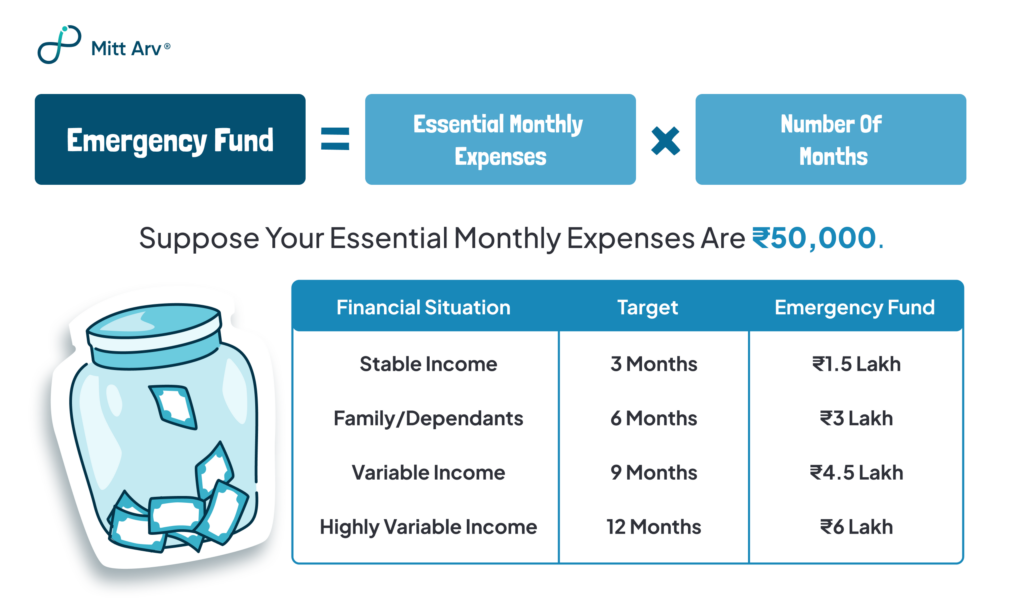
The 3-6-12 rule is a planning framework, not a regulatory requirement. Your actual target should reflect your income stability, debt, dependants, insurance coverage and financial obligations.
Why Emergency Savings Matter
The idea behind emergency savings is supported by academic research.
Economist Annamaria Lusardi has extensively studied financial fragility and precautionary saving. Her research highlights the importance of households having resources available to deal with unexpected financial shocks.
Similarly, economist Christopher Carroll’s work on buffer-stock saving examines how households accumulate financial reserves as protection against income uncertainty and unexpected expenses.
The underlying principle is simple:
People need financial buffers because income and expenses are uncertain. An emergency fund provides that buffer. It can prevent a temporary financial problem from turning into a long-term debt problem.
What Does RBI Data Tell Us?
The importance of financial reserves becomes clearer when we look at India’s household finances.
According to the RBI Annual Report 2024-25, household gross financial saving increased from 10.7% of Gross National Disposable Income (GNDI) in 2022-23 to 11.2% in 2023-24.
Household financial liabilities stood at 6.1% of GNDI, while net household financial saving increased to 5.1% of GNDI in 2023-24, compared with 4.9% in 2022-23.
These figures describe household finances at the macroeconomic level. They do not establish a particular emergency-fund target for an individual.
For an individual household, the more useful question is:
If my income stopped tomorrow, how many months could I continue paying for essential expenses without selling long-term investments or taking expensive debt?
That is the purpose of an emergency fund.
What Should You Include in Your Calculation?
Your emergency fund should generally be based on essential monthly expenses, rather than your entire lifestyle expenditure.
Consider including:
- Rent or home-loan EMI
- Groceries
- Utilities
- Essential transportation
- Education expenses
- Insurance premiums
- Necessary medical expenses
- Loan repayments
- Essential household costs

For example, if your normal monthly expenditure is ₹80,000 but your household could function on ₹55,000 during a crisis, ₹55,000 may be a more appropriate figure for calculating your emergency fund.
Where Should You Keep Your Emergency Fund?
An emergency fund should prioritise liquidity and capital safety.
Keeping the entire fund in high-risk investments can defeat its purpose.
One practical approach is to divide the reserve into layers.
1. Immediate-access reserve
Keep roughly one month’s essential expenses in a savings account or another highly accessible form.
This is your first line of defence.
2. Short-term reserve
The next portion can be maintained in relatively safe and liquid options, such as suitable bank fixed deposits or other appropriate low-risk instruments.
3. Extended reserve
If your income is unpredictable or you have substantial financial responsibilities, maintain additional reserves covering several more months.
The greater the uncertainty surrounding your income, the more valuable liquidity becomes.
Emergency Fund vs Insurance
An emergency fund does not replace insurance.
Insurance protects against specific risks, while an emergency fund provides immediate liquidity.
For example, health insurance may cover a significant portion of a medical expense, but your family may still face deductibles, medicines, travel costs, exclusions or temporary loss of income.
Similarly, life insurance can provide financial protection to dependants, but it does not function as an emergency savings account.
A financially resilient household therefore needs multiple layers:
Insurance → Emergency Fund → Investments → Long-Term Wealth → Estate Planning
Each layer serves a different purpose.
What Happens When You Use Your Emergency Fund?
Using your emergency fund does not mean your financial planning failed.
That is literally what the fund is for.
If you have ₹4 lakh saved and spend ₹1.5 lakh during an unexpected emergency, your next objective should be to rebuild the reserve.
You can temporarily redirect a portion of your monthly savings until the fund reaches your target again.
The goal is not to maintain a perfect balance forever.
The goal is to maintain financial readiness.
Your Emergency Fund Is Only the Beginning
Emergency savings protect your household against an immediate financial shock.
But financial preparedness extends beyond having money in a bank account.
Your family also needs to know:
- What assets you own
- Where those assets are held
- Which insurance policies exist
- Where important documents are stored
- What investments you have
- Who should be contacted
- What happens to those assets if you are no longer around
This becomes particularly important when families have multiple bank accounts, demat accounts, insurance policies, real estate, digital assets or assets spread across different countries.
An emergency fund protects your family from financial shocks today.
Organising your assets helps your family navigate financial uncertainty tomorrow.
Build Your Financial Safety Net With Mitt Arv

Start with the basics.
Calculate your essential monthly expenses. Multiply them by an appropriate number of months. Keep the money accessible. Review the amount whenever your income, family responsibilities or debt changes.
Then look beyond the emergency fund.
Because financial planning is not simply about accumulating wealth. It is also about making sure the people you care about can find, understand and access that wealth when you are not there to explain it.
With Mitt Arv, you can organise your financial assets, important information and family financial records in one secure place, helping turn a collection of scattered financial details into a structured financial legacy.
Build your emergency fund. Organise your assets. Protect what you have built with Mitt Arv.