

Have you ever wondered what happens to someone’s house, money, or land after they pass away? Who gets it?
Does it automatically go to the children? What if there is no will?
These are questions thousands of Indian families face every year. And the answers depend on something called inheritance law. Understanding these rules can help avoid confusion, disputes, and even legal battles within families. Let us break “Hindu law of Inheritance” in simple, easy-to-understand language so you know your rights and what the law says.
What Is Inheritance Law in India?
Inheritance law basically decides who gets a deceased person’s property after they pass away. This includes land, houses, bank accounts, jewellery, businesses, and even debts.
In India, there are two main ways a person’s property can be passed on:
1. Through a Will: The person writes a document before dying, clearly stating who gets what. This is called testamentary succession.
2. Without a Will (Intestate Succession): If a person passes away without writing a will, the law steps in and decides how the property is divided among the family members.
India is unique because different religions have different inheritance laws. Hindus, Muslims, and Christians all follow different rules.
The Two Types of Property You Should Know About
Before we get into who gets what, it is important to understand the difference between two types of property in India.
Ancestral Property is property that has been passed down through at least four generations. Think of your great-grandfather’s land that your grandfather inherited, then your father, and now you. The interesting thing about ancestral property is that children have a right to it from the moment they are born. A father simply cannot sell or give away ancestral property without the consent of his children. The children have a legal claim to it by birth itself.
Self-Acquired Property is completely different. This is property that a person bought or earned using their own money. If your father worked hard, saved money, and bought a flat in Patiala with his own earnings, that flat is his self-acquired property. He can sell it, gift it, or will it to anyone he chooses. His children have no automatic right to demand a share in it.
Here is a simple illustration to make this clearer:
Mr.Singh owns two properties. One is a farmland that came from his grandfather, and the other is a house he bought himself in 2005. His son has a birthright to the farmland. But his son has no automatic right to the house. Mr.Singh can give that house to a charity, a friend, or anyone he wishes.
Hindu Law of Inheritance: The Hindu Succession Act, 1956
Most Indians are governed by the legal authority Hindu Succession Act of 1956. This law applies not just to Hindus but also to Buddhists, Jains, and Sikhs.
When a Hindu man passes away without a will, his property goes first to what the law calls Class I heirs. These are the closest family members and they all inherit equally at the same time. Class I heirs include:
- Wife
- Sons and daughters
- Mother
- Grandchildren (if their parents are deceased)
Only if there are no Class I heirs does the property move to Class II heirs, which includes the father, brothers, sisters, and more distant relatives.
Example: Mr.Kumar passes away without a will, leaving behind his wife, one son, and one daughter. All three are Class I heirs. So the property gets divided into three equal parts. The wife gets one-third, the son gets one-third, and the daughter gets one-third. Simple and equal.
The Hindu Succession (Amendment) Act, 2005 changed everything.
Before 2005, daughters had a disadvantage under Hindu law. They were considered members of the family but not coparceners, which means they did not have an automatic right in ancestral property the way sons did.
The Hindu Succession (Amendment) Act, 2005 changed everything. It declared that daughters are now coparceners by birth, just like sons. This means daughters have the exact same rights as sons in ancestral property. They can ask for their share, they can ask for partition of the property, and they can even become the Karta (the manager of a joint Hindu family).
This was a massive step forward for gender equality in India. But this one case established the rights of women forever.
A Landmark Court Case: Vineeta Sharma vs Rakesh Sharma (2020)
This is one of the most important Supreme Court cases on inheritance in recent Indian history, and it is worth knowing about.
The case involved a daughter who was claiming her share in her father’s ancestral property. The question before the court was whether the 2005 amendment applied to daughters even if their father had already passed way before 2005.
The Supreme Court gave a clear and powerful answer: yes, it does. The court said that a daughter’s coparcenary rights are hers by birth. It does not matter whether her father was alive or dead when the 2005 amendment came into force. She still has equal rights to the ancestral property.
This judgment helped thousands of women across India claim property that had wrongly experienced denial of ancestral property to them for years.
Rights of a Spouse: Husband and Wife
Under Hindu law, both husbands and wives have inheritance rights when their partner is no longer alive.
If a Hindu wife passes away without a will, her property goes first to her children and husband equally. If there are no children, it goes to the husband’s heirs.
If a Hindu husband passes away without a will, his wife is a Class I heir and inherits equally along with the children and his mother.
A common question people ask: “My father remarried after my mother passed away. Can the second wife claim a share in the property?”
The answer is yes. A legally married second wife is also a Class I heir and has the same inheritance rights as the first wife’s children. However, if the second marriage was illegal (for example, if the first wife was still alive), then the second wife has no inheritance rights.
Rights of Grandchildren
Grandchildren become Class I heirs only if their parent (the deceased person’s child) has passed away before the deceased
Example: Mohan has two sons, Ravi and Arun. Ravi passes away before Mohan. When Mohan eventually also passes away, Ravi’s children (Mohan’s grandchildren) are entitled to receive Ravi’s share. They do not lose their inheritance just because their father had deceased first.
Rights of Adopted Children
Under Hindu law, an adopted child has the same rights as a biological child. The moment a child is legally adopted, they become full members of the adoptive family for all legal purposes, including inheritance. They can claim their share in ancestral property and in the self-acquired property of the adoptive parents (if there is no will).
What Happens If There Is No Will and No Heirs?
This is a rare but interesting situation. If a person leaves behind no surviving legal heirs at the time of his passing, and there is no will, the property eventually goes to the government. This is called escheat. It is the legal system’s way of making sure no property is left completely ownerless.
Inheritance and Tax: Good News for Most People
Many people worry about having to pay tax when they inherit property. Here is some reassuring news: India does not have a direct inheritance tax. When you receive property through inheritance, you do not immediately have to pay tax on it.
However, if you later sell that inherited property, you may have to pay capital gains tax. The calculation is based on what the original owner paid for it, not what it was worth when you inherited it. This can sometimes result in a larger tax bill than people expect, so it is wise to consult a tax expert before selling inherited property.
There are also stamp duty and registration charges involved when you formally transfer property into your name, and these vary from state to state.
Take Control of What You Leave Behind
Life is unpredictable. Your assets should not be.
Whether you own property in India, a bank account in Singapore, or investments spread across countries like the USA, UAE, and beyond keeping track of everything can feel overwhelming.
And when something happens to you, your loved ones are left scrambling through paperwork, searching for answers at the worst possible time.
Mit Arv’s Asset Vault changes that.

Store and organise all your assets across multiple nations in one secure place. Add property, bank accounts, investments, insurance policies, digital assets, and more, all under one roof. Update details in real time whenever something changes.
The best part? You decide who sees what and when. Share your asset information instantly during an emergency, or ensure your loved ones have access exactly when they need it most, even after you are gone.
No more confusion. No more missed assets. No more unnecessary legal battles.
Create Collaboration Groups and invite your trusted family members, lawyers, or advisors to manage assets together. Everyone stays informed, organised, and prepared.
Your life’s work deserves to be protected and passed on smoothly.
Start building your Asset Vault today with Mit Arv and give your family the gift of clarity.
FAQs on Hindu Inheritance Law (India)
1. Explain Inheritance And Succession Under Hindu Law.
Succession is either testamentary (by Will) or intestate (by law).Without a Will, the Hindu Succession Act dictates asset division. Law prioritizes Class I heirs, ensuring a rigid legal transfer.
2. Who are Class I heirs under Hindu law?
Class I heirs include the spouse, children (sons and daughters), mother, and heirs of predeceased children. They get equal shares.
3. Do daughters have equal rights as sons?
Yes. After the 2005 amendment to the Hindu Succession (Amendment) Act, 2005, daughters have equal coparcenary rights as sons.
4. Does the wife get the entire property?
No. The wife shares the property equally with other Class I heirs like children and the mother of the deceased.
5. What if there are no Class I heirs?
Then the property passes to Class II heirs such as the father, siblings, and other relatives.
6. Can a mother inherit her son’s property?
Yes. The mother is a Class I heir and receives an equal share along with other Class I heirs.
7. What is coparcenary property?
It is ancestral property where family members acquire a birthright interest, mainly governed under Hindu joint family law.
8. Do adopted children have inheritance rights?
Yes. Legally adopted children have the same inheritance rights as biological children.
9. Can stepchildren inherit property?
Stepchildren do not automatically inherit unless legally adopted.
10. How can inheritance disputes be avoided?
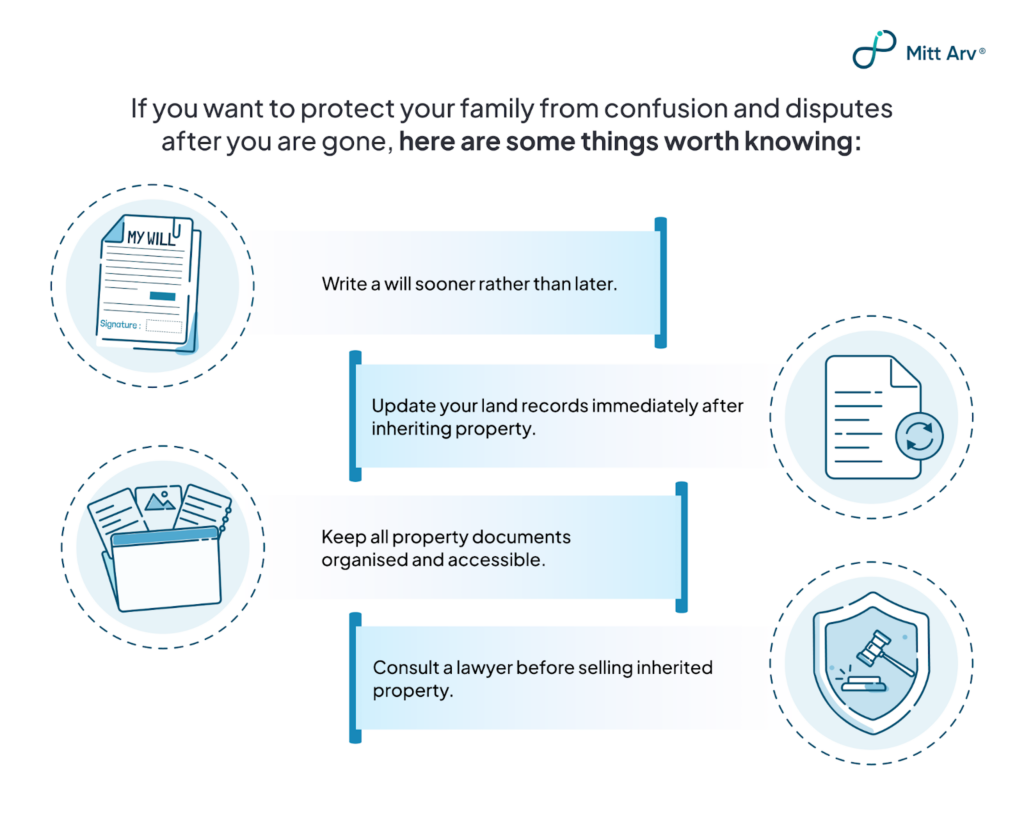
By creating a valid will, clearly outlining asset distribution, and keeping documentation updated.